
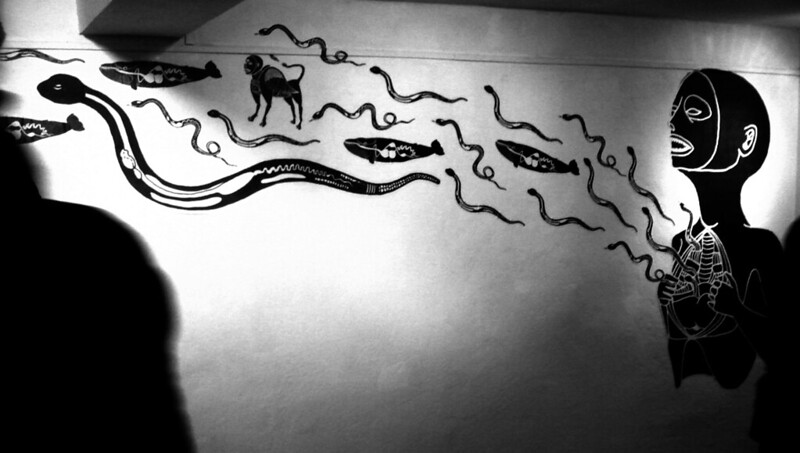
Difference has not been defined the same way throughout history. There have been and continue to be distinctions of class, gender, sexuality, language, religion, and, race. Race science originally emerged as a method to prove that race gives fixed differences between people. It was an attitude towards difference that insisted upon scientific and statistical distinction and refused the sociogenic understanding of race as a social construction. It has been exploited across history as ‘evidence’ and justification for the marginalisation, mistreatment, and eradication of various groups of peoples. Modern racism arguably has its origins within Europe, where nations formed the loose basis for discrimination. The Romans designated certain groups ‘barbarians’ for their backwardness (Robinson). Time moved on and serfs were freed only to be put into wage labour and, alongside Mediterranean mercantilism built on slave labour, made up the foundations of modern capitalist Europe. Robinson’s work, Black Marxism, uses the phrase ‘Herrenvolk’ to describe this process, where a marginalised group were created with the clear intention of economic or political benefit to the majority.
For most of contemporary history, blackness has been defined in opposition to whiteness. Black is, to put it simply, not white. However, this distinction goes both ways. Every positive attribute attached to whiteness is absent in blackness, and every negative attribute attached to blackness is absent in whiteness. Toni Morrison calls this the ‘major benefits in creating and sustaining an Other.’ By emphasising one distinction, others can blur, creating a sense of unity against a common enemy. Here, that enemy is the black man or woman, but this is a common process that has been applied to many groups. Crime, poverty, dirtiness, and perversion can be intentionally attached to notions of what the Other is, providing a scapegoat. Every time the hegemonic group feels threatened, all fingers can point at the marginalised figure that they have themselves created.
In his deconstructive work on black consciousness, Frantz Fanon discusses the ‘basic importance’ of language to this process of othering. Not only is the Other robbed of his freedom, but he is robbed of his culture and identity. He is left a blank canvas for new ideas to be painted onto. A history of exploitation and colonialism has fenced blackness into a definition of inferiority and demonisation. In Fanon’s words, ‘the black is not a man […] the black is a black man.’ Blackness can only be articulated and experienced through the presence of its alternative: whiteness. This process of elimination and replacement is impersonal and strategic, and the new identity is never accidental. The imposition of identity is what then allows for the exploitation and discrimination of the Other.
As a movement, black radicalism emerged in deliberate opposition of this fact. It was and is a reaction from the African diaspora to the oppression that has resulted from the imposition of an identity that was never theirs. Abolition and resistance movements have furthered the cause and ensured that it is rooted in the real and actual lives of those affected by the othering of blackness. In academia, black radicalism has taken the form of ‘decolonization as a critical practice’ (bell hooks), as well as postcolonial studies. History is taught with lived experiences in mind, rather than an external narration of an exotic Other. This contributes to the development of a ‘world-historical consciousness’ (Robinson).
This concept of ‘black consciousness’ is at the heart of black radicalism (Sharpe). It vehemently denies the restraint of identity by negation and defines itself in its own right. Blackness is blackness. It is the shared experience of black people in the twenty-first century. It is a recognition of the systems and infrastructure that serve to oppress black people. Most of all, it is a persistent recognition that the black struggle did not end with abolition, and that black radicalism must continue to unashamedly exist until its identity is wholly and truly its own.
Image: Andreco on Flickr