
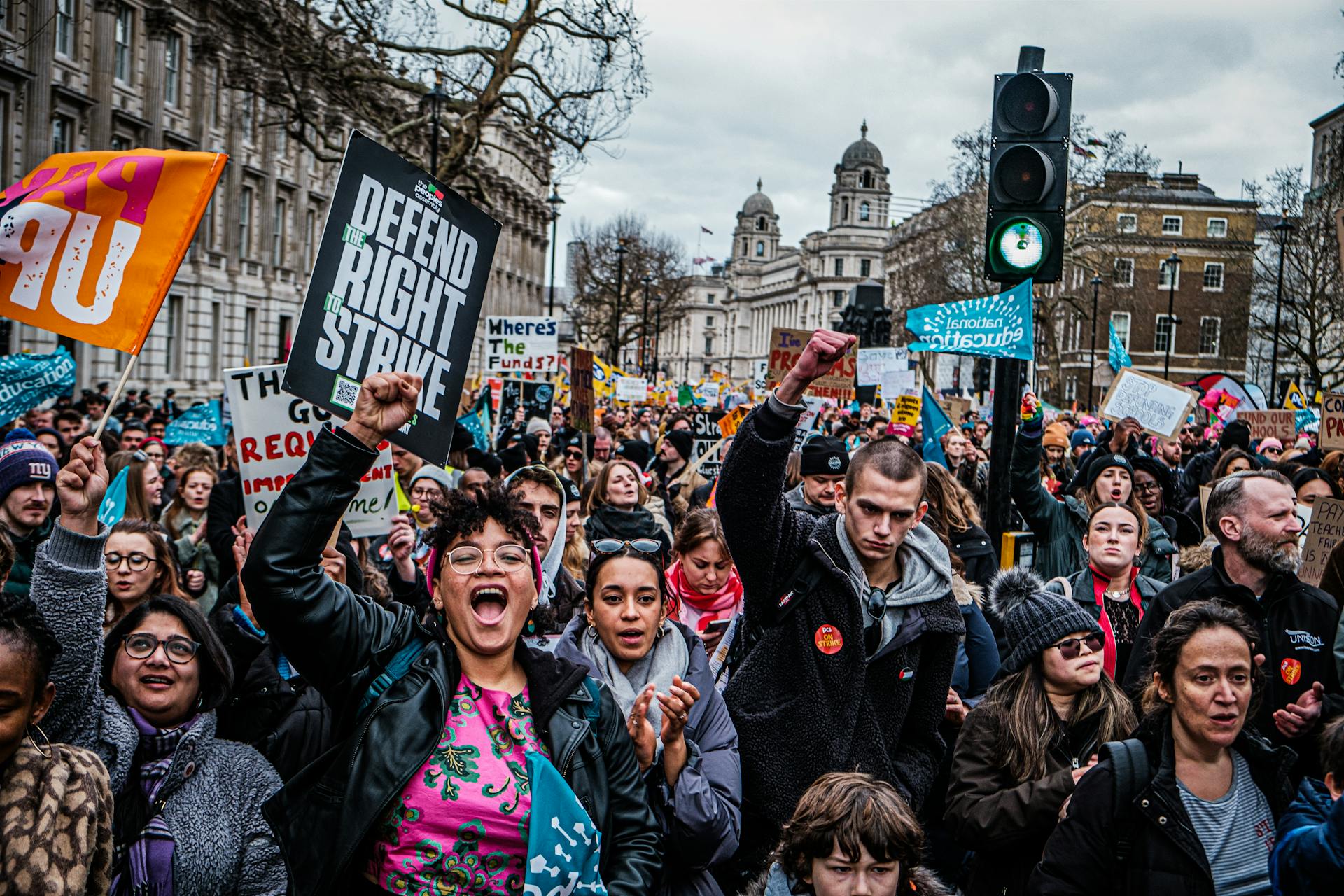
Everyone believes in the right to protest until they are late for work, stuck in traffic, or trying to get to class.
In theory, protest is one of the clearest signs of a healthy democracy. In practice, it is often treated as a public nuisance: too loud, too disruptive, too inconvenient, or simply too annoying to tolerate.
This is the central contradiction in how Britain talks about protest. We praise it when it is safely in the past, when it belongs to suffragettes, civil rights movements, or trade unionists from decades ago. Yet when protest happens in the present, in real streets, with real disruption, it is often received very differently. The question is not whether people support the right to protest in principle. Most would probably say they do. The more revealing question is whether we still support protest when it interrupts everyday life.
Legally, the right to protest in the UK is mainly protected through the rights to freedom of expression and freedom of assembly. Article 10 of the Human Rights Act protects the right to express opinions, including through public protest and demonstrations, while Article 11 protects the right to gather with others in meetings or demonstrations. However, these rights are not absolute. Public authorities can restrict them if the restriction is lawful, necessary and proportionate, for example to protect public safety, prevent disorder or crime, or protect the rights of others.
That balancing act sounds reasonable enough. Nobody is seriously arguing that protest should mean a total free-for-all. The right to protest doesn’t automatically include the right to intimidate people, endanger lives, or cause unlimited disruption with no consequences. But the difficult part is where the line gets drawn. At what point does disruption become unacceptable? And who gets to decide?
This has become especially important in recent years, as protest law in England and Wales has tightened. The Police, Crime, Sentencing and Courts Act 2022 strengthened police powers to place restrictions on protests, while the Public Order Act 2023 created new protest-related offences, including offences around “locking on”, tunnelling, obstructing major transport works and interfering with key national infrastructure.
To supporters of these laws, this is about protecting ordinary people from a small number of protesters who cause unacceptable disruption. To critics, it represents something more worrying: a slow narrowing of what protest is allowed to look like. If protest is only protected when it is quiet, brief, orderly and easy to ignore, then it risks becoming less like a democratic right and more like a managed performance.
The phrase “serious disruption” sits at the centre of this debate. It sounds simple, but it can cover a wide range of situations. A march might disrupt traffic. A sit-in might disrupt a university’s ability to hold classes. A public demonstration might disrupt a road or public event .But disruption is often the whole point of protesting. Protest exists because normal channels have failed, or because protesters believe those in power are not listening. If a protest causes no interruption, discomfort or attention, it may also cause no political pressure.
Recent Home Office statistics show that between 28 June 2022 and 31 March 2025, police powers under sections 12, 14 and 14ZA of the Public Order Act 1986, as amended by the 2022 Act, were used to apply conditions to 640 protests in England and Wales. Of these, 465 were processions and 175 were assemblies. The same statistics recorded 519 arrests for breaching conditions at processions or assemblies. These figures don’t prove that all restrictions were unjustified, but they do show that protest is increasingly being shaped by legislation that determines where people can march, how long they can gather, how loud they can be, and what counts as crossing the line.
This matters because public opinion around protest is often deeply inconsistent. A protest we agree with is brave. A protest we dislike is selfish. A march we attend is democracy in action. A march that delays our bus is an outrage.
This is especially visible in responses to climate protests, Palestine solidarity marches, strikes, university encampments and other forms of direct action. The debate quickly shifts away from the issue being protested and towards the behaviour of the protesters themselves. Are they too disruptive? Too emotional? Too confrontational? Too inconvenient?
Of course, inconvenience is not imaginary. Disruption can have real consequences. People may miss hospital appointments, lose wages, or feel unsafe. These concerns should not be dismissed. A serious defence of protest rights has to acknowledge that protests affect people who may have no power over the issue being protested. But inconvenience alone cannot be enough to delegitimise protest. If it were, almost every effective protest movement in history would have been condemned on the same grounds.
There’s also a danger in romanticising past protest while sanitising what it actually involved. The suffragettes were not universally admired in their own time. Trade union action has often been portrayed as selfish or economically damaging. Anti-war movements have been dismissed as naïve or unpatriotic. Many protests that are now remembered as morally obvious were once treated as disruptive, dangerous or extreme. That does not mean every modern protest will be vindicated by history, but it should make us cautious about assuming that public irritation is the same thing as moral failure.
Ultimately, the right to protest is not really tested when the protest is polite, popular and out of the way. It is tested when protest is noisy, uncomfortable and inconvenient. That is when society has to decide whether it genuinely values dissent, or only tolerates it when it does not have to notice.
A democracy that only allows convenient protest is not protecting protest at all. It is protecting the appearance of dissent while removing much of its power. The real question, then, is not whether protest should have limits. It should. The question is whether those limits are being drawn to protect the public, or to make protest easier to ignore.
Image by Stan Platt-Jones on Pexels.