
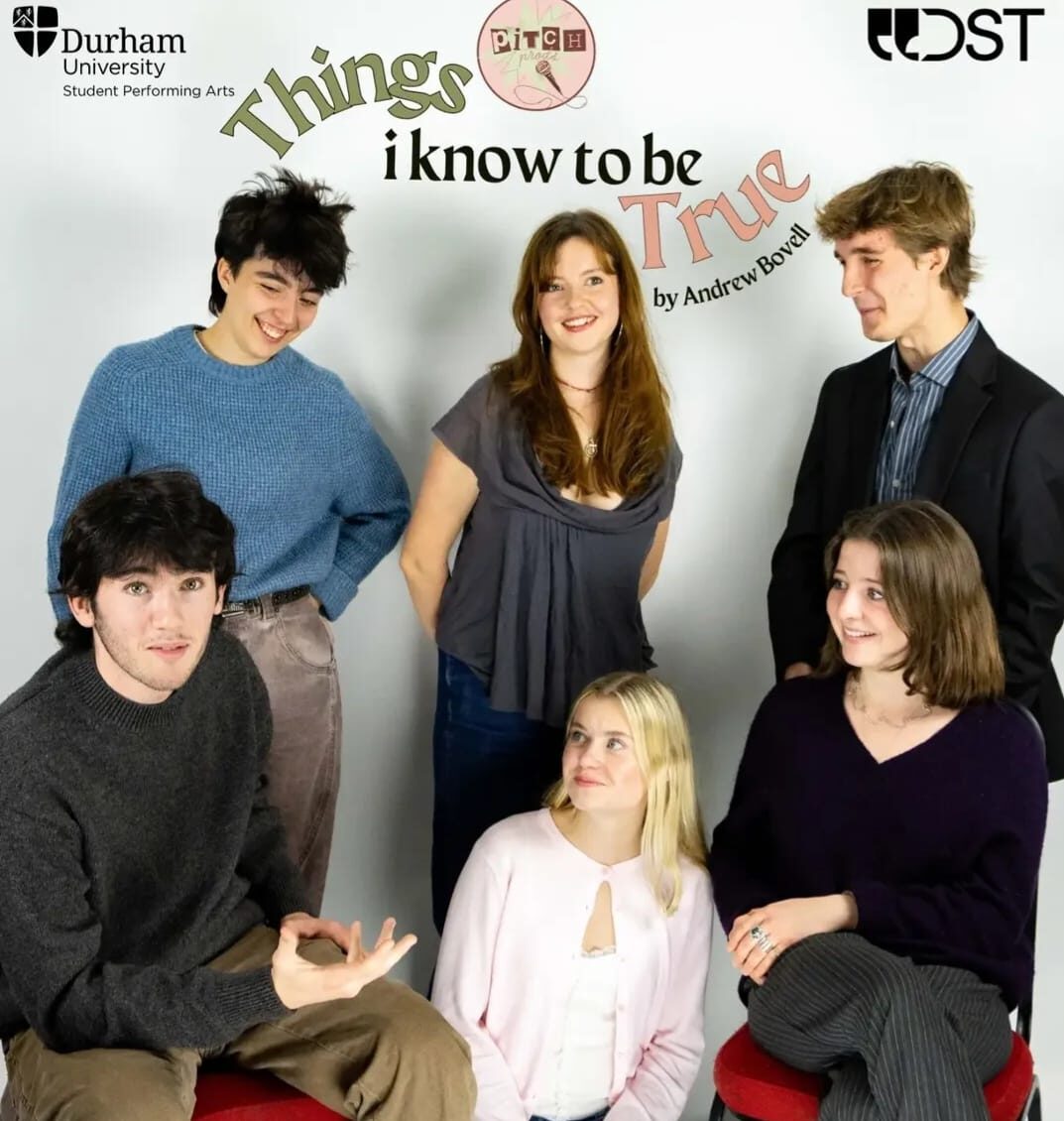
Very few family dramas capture the deep complexities of love, loyalty and perpetual change as powerfully as Things I Know to Be True by Andrew Bovell, and Pitch Production’s rendition did it more than justice. Through honest performances and deeply emotional scenes, the production managed to explore how a family can struggle to reconcile individual dreams with shared expectation. From the opening scene, the play combined emotional depth with relatable characters, leaving an undeniably lasting impression on the audience.
The play follows the Price family as each of the four children navigates major turning points in their lives. Through a series of personal revelations, parents Bob (Isaac Slater) and Fran (Cara Crofts) are forced to confront the reality that comes with their children growing up: that they are becoming their own people, making their own mistakes, and leaving them behind.
This play is undoubtedly difficult to tackle due to the intense emotional fluctuations throughout. However, Pitch’s production handled in masterfully. Under the direction of co-directors Harvey Hill and Iphis Critchlow, with the help of Beau Singleton as assistant director, not only were these themes approached sensitively, they were also allowed to truly shine. This achievement was further supported by the work of producer Rhiannon Morgan, whose work helped bring together a cohesive production.
Furthermore, the light comedy of the play was well drawn out, giving much needed relief to what would otherwise become an intensely depressing watch. Both moments of silly family dynamics as well as fraught arguments felt authentic and lived-in. Nothing felt redundant, with every scene leaving the audience laughing, shocked or crying. That is truly a testament to the directors.
However, the success of this production is equally due to the sheer talent that every single one of the actors brough to the stage. Phenomenal performances were seen from every single one of them and, almost more importantly, together they produced a truly believable family that clearly cares deeply for one another.
Family dynamics as well as fraught arguments felt authentic and lived-in
Bob, performed by Isaac Slater, provided a much needed emotional anchor for the audience. His good natured demeanor and firm morals gave him wonderful relatability. He fully embodied a man in his early sixties and it was clear great care had been put into aging his movements. He created a father that was calm in almost every situation and comedy often came from his characterisation, something that made it all the more impactful when we saw him break in one of the most heart-wrenching scenes of the play. He gave an astounding performance of a man stricken with the shock of sudden grief as well as a father who’s family means the world to him.
Equally as strong was Cara Crofts who stood opposite Slater as Fran. Fran, one of the most complex characters of the play, is both incredibly concerned for her children and often hyper-critical of them. This contradiction makes her a very tricky character to play, but Crofts handled this challenge with absolute ease. In the scene where we discover Mark is transitioning to become Mia, Crofts displayed astonishing versatility, teetering on the edge of emotional breakdown while simultaneously holding it together. Her bodily control was exceptional as she visibly shook on stage. She was both a pragmatic mother and a women who, behind the scenes, was dealing with her world falling apart.
The show’s lighting, designed by Layla Aysan and Dan Haines, was ingenious. It accented moments beautifully. Throughout monologues, spotlights were used to isolate people from the family, allowing them to feel truly introspective. By isolating characters, the lighting reinforced that even within a loving family, each member ultimately faces their struggles alone. It worked outstandingly alongside the set through the use of the windows where times of day could be seen as well as the arrival of Ben’s car, a moment that set the tension wonderfully for the ensuing scene.
The set design itself was fabulous. Production manager Cameron Howe, stage manager Martha Warde and assistant stage manager Lily Beetles created a homely family kitchen, with the apron used as the Price family garden. The changing seasons mirrored shifting family dynamics, while family photographs added a lived-in quality that made moments of distress all the more affecting.
River Blatch (Mia), gave a compelling performance, handling poignant and current themes with tact and ease. Their dynamic with Sophia Jenkins (Rosie) was incredibly heartfelt, while Blatch clearly conveyed the inner turmoil of a character torn between personal happiness and family expectations. Blatch’s nervous demeanor was a highlight of many of the productions harder hitting scenes.
As Ben, Tristan Olesiak expertly captured the pressure of being the Pirce family’s apparent success story. On the surface, Ben arrives confident and self-assured, yet as the production progresses this façade begins to crack. Olesiak’s performance balanced charm with intense underlying insecurity, making the Ben’s drug-charged scene all the more impactful. He allowed the audience to witness the character’s gradual unravelling and his physicality is what truly sold it, the confident upright man was reduced to a small boy hiding from his mistakes and cowering from his father.
sheer talent … every single one of the actors brought to the stage
The production created tension very well, and the sound design was tantamount in this. Katie Masden’s addition of distorted tones at the beginning of the show, as well as throughout, very effectively set up dramatic scenes. Bird song in the garden, music on the radio and ringing phones all added to the naturalistic nature of the production, although sometimes it could be slightly loud and lines were lost behind it.
A particularly memorable performance came from Lottie Roddis as Pip, whose fierce independence provided some of the productions most charged moments. Roddis dealt incredibly well with lengthy monologues, maintaining the audience’s attention throughout through great pacing and facial expressions. What could have easily become a one-dimensional portrayal instead felt deeply human, allowing the audience to understand both Pip’s frustrations and her desire for acceptance. Her scenes with Fran were particularly absorbing, highlighting generational tensions as well as setting Pip up as Fran’s foil very effectively.
Sophia Jenkins delivered a deeply affecting performance as Rosie, whose warmth and vulnerability made her instantly endearing to the audience. Jenkins encapsulated the youngest child well with a performance that was both charming and deeply sincere. Even when Rosie spent long stretches observing rather than participating, Jenkins remained fully engaged, ensuring the character always felt integral to the family dynamic. Her reactions were often just as telling as the dialogue itself.
Fundamentally, Things I Know to Be True succeeds because of its deeply human portrayal of family. Pitch’s production never shied away from the play’s difficult themes, instead embracing them with sensitivity, humour and remarkable honesty. Supported by exceptional performances and thoughtful technical design, this was a production that left a lasting impression on the audience long after the final scene. It serves as a reminder that while families may not always understand one another, the bonds that tie them together remain through every mistake, disappointment and triumph.
‘Things I Know to Be True’ was performed at the Assembly Rooms Theatre from 12th November to 14th November by Pitch Productions
Image: Ptich Productions via Instagram