
How seriously should we take climate change?
The environment is certainly an issue that people are wary of and anxious about, particularly amongst young people, given the growing popularity of the Green Party. Yet the worsening impacts of climate change and the phenomena that trigger it can often be buried in the media. The impacts of climate change are not just a loose theory either, but rather a statistic that organisations are confident in. The World Health Organisation (WHO), for example, projects that climate change will be responsible for 250,000 deaths per year between 2030 and 2050. Every year, we see destructive natural disasters seem to increase in severity and frequency. This year alone, severe wildfires in Canada affected air quality as far as the densely populated cities of Toronto, New York, and Philadelphia. The trigger for these arid conditions, which allowed the wildfires to take place, has been partially attributed to the El Niño effect.
What is the El Niño effect?
El Niño is rapidly becoming more of a recognisable term, particularly this year, which has been projected to be a ‘Super El Niño’. Most people are likely familiar with the term, seeing it discussed on the news and social media, but what actually is it, and why is it so crucial to understand?
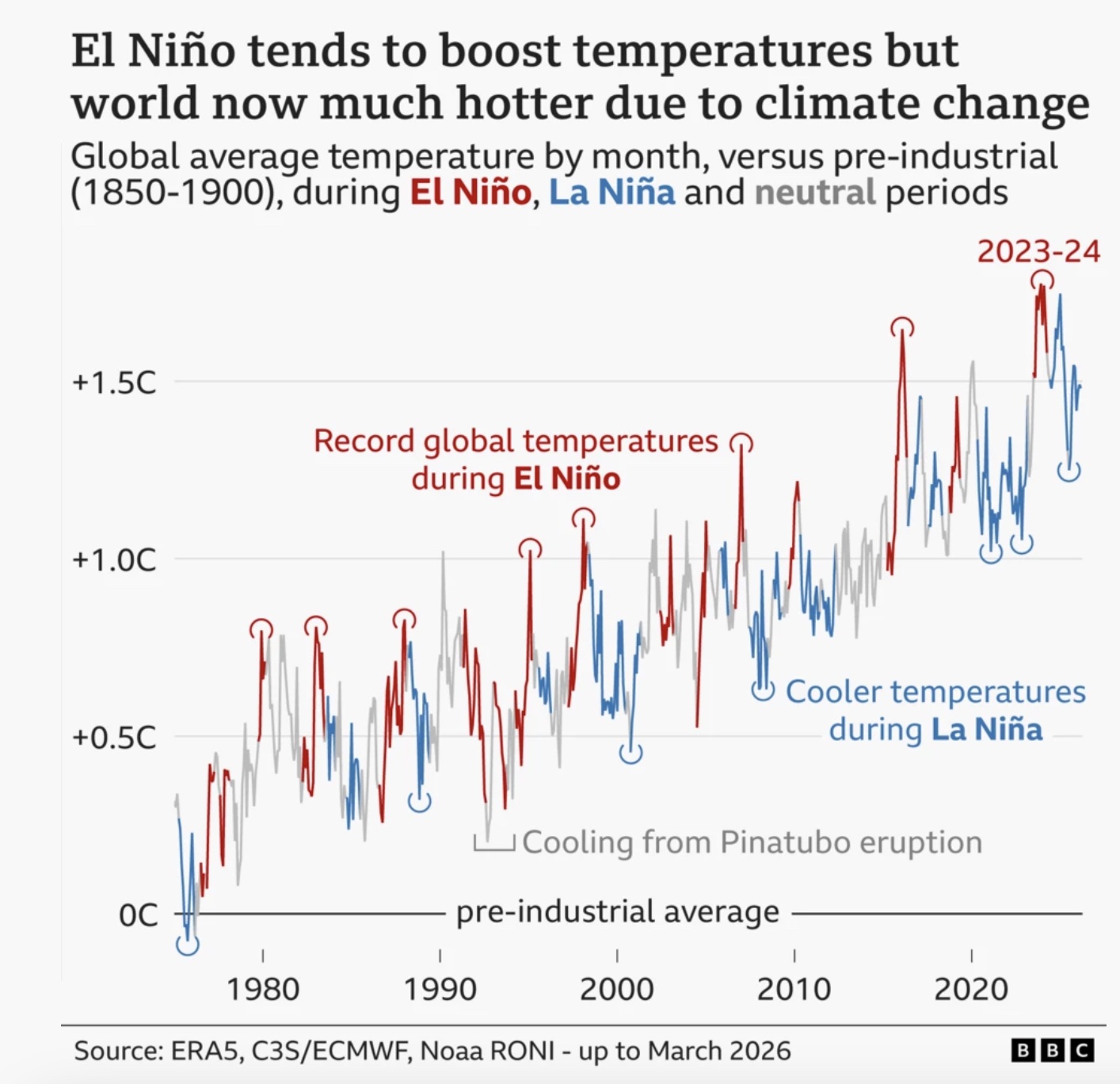
El Niño, a term meaning ‘the boy’ in Spanish, is part of the climate pattern named El Niño Southern Oscillation (ENSO) that occurs, interchangeably with its counterpart ‘La Niña’, every 2-7 years. During the El Niño pattern, trade winds weaken, which pushes warm water back east towards the west coast of the Americas. As a result, this leads to the Pacific jet stream being pushed south, leading to dry, warm conditions in the northern U.S., Canada and parts of South America. The National Oceanic and Atmospheric Administration (NOAA) stated that the chance of the El Niño being ‘very strong’ during its current pattern was 63%, and evidence continues to point towards this.
How is the severity of El Niño worsened by people?
The reason why El Niño is so crucial to have a grasp on is the detrimental impacts it is having on our environment, particularly when accompanied by human-induced climate change (burning of fossil fuels, deforestation, etc.). The warmer the ocean becomes, the higher the air temperature tends to be, explaining why El Niño events seem to be coupled with some of the hottest years on record. Essentially, El Niño would warm the planet regardless, but due to anthropogenic climate change, its impacts have become more severe.
The vulnerability of food security and political tensions
It is clear that El Niño contributes to, or at least is intensified by, climate change. But often some of its impacts aren’t so clear. Conditions are already expected to be drier in areas of South and Central America and Southeast Asia. This is likely to lead to droughts and food shortages in areas which are responsible for high production. With a growing global population and limited resources, food insecurity is an urgent issue, and El Niño is only making it increasingly vulnerable. The World Food Programme visited a farm in Jalapa, Guatemala, where crops had barely reached half of the expected normal height. In Honduras, similar impacts were visible; wells were dry, crops were diminished, and livestock were dying.
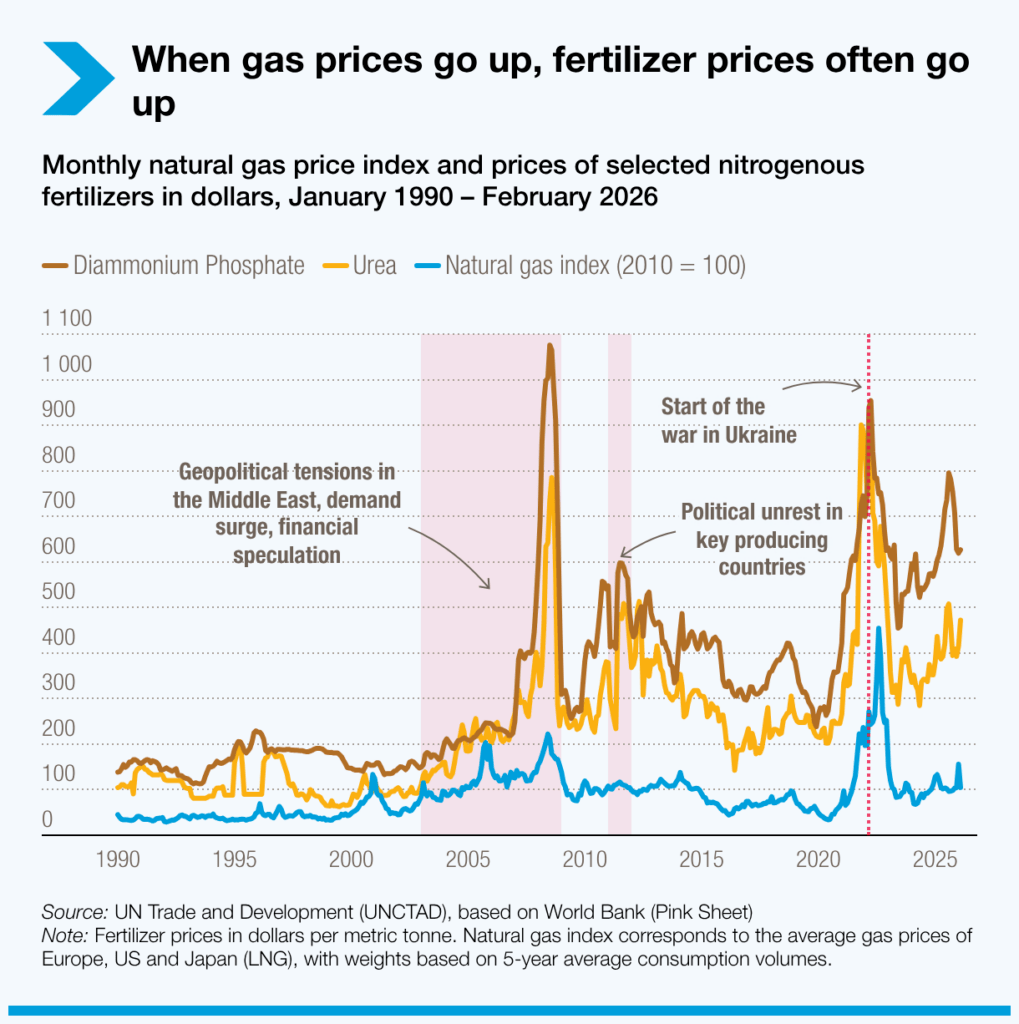
Crop failure in Central America does not just have a localised impact but a global one. In a globalised world, the UK imports 40% of its food, including 80% of its fruit and 47% of its vegetables, much of which is from Central and South America. The UN’s Intergovernmental Panel on Climate Change has stressed that without intervention, higher temperatures will continue to produce lower yields and poorer quality fruits and vegetables. Human impact does not just worsen the impacts of El Niño in terms of increasing global temperatures but also the detrimental impacts of political tensions. The effective closure of the Strait of Hormuz has been labelled a ‘global chokepoint’ and has trapped 30-40% of globally traded fertilisers. This has left farmers internationally struggling to fertilise their crops when they’re at their most desperate due to the El Niño-driven droughts. Political tensions breed shipping disruptions, and that, accompanied by a vulnerable climate, puts the Earth in a very dangerous position.
What now?
“El Niño conditions will pour fuel on the fire of a warming world. Impacts will hit even harder, travel even farther, and cross borders with devastating speed,” the UN’s Secretary-General, António Guterres, warned. The future of the climate is unnerving, especially when the UN has made such serious claims, yet drawing attention to issues which are often tossed aside can be the catalyst for change. With the return of COP 31 this month, from 9th to 20th November in Antalya, Türkiye, discussing these issues is more important than ever, and it is imperative that we keep discussing them.