
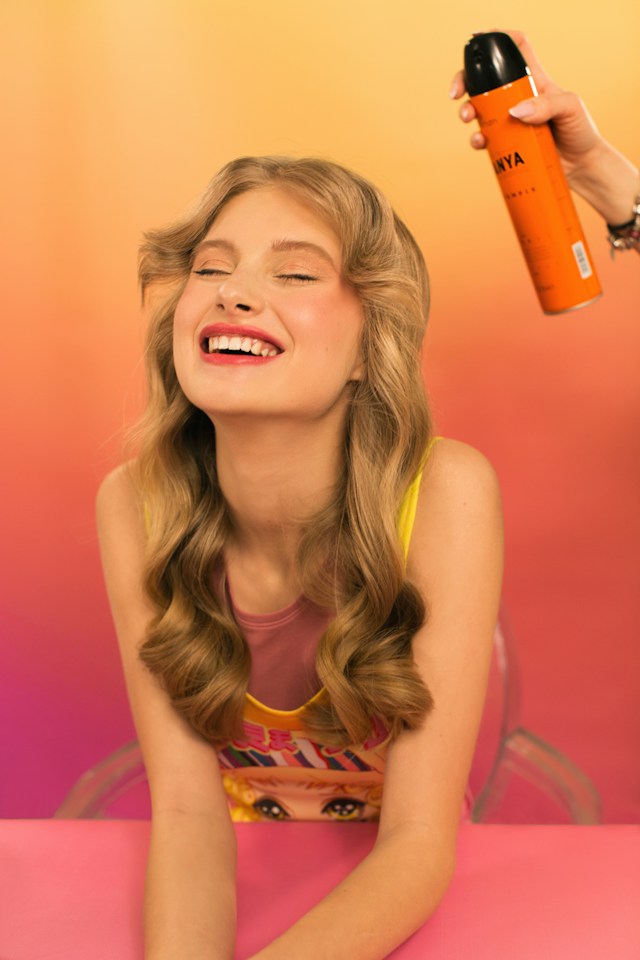
The 70s and 80s saw a surge in the use of hairspray as a mode of self-expression. The debut of Charlie’s Angels in 1976 introduced the wider public to the pivotal Farrah Fawcett, who played the iconic Jill Munroe. Her striking, blonde hairstyle hooked the audiences of the drama to a multitude of hair products. She appeared in television adverts, promoting shampoos, conditioners, hair stylers, as companies decided to capitalise on the overwhelming desire people had to replicate her hair. It became ‘a famous trademark’, as it consisted of dramatic layering, a shaggy fringe and an intense blow-out. Yet its influence was not merely limited to the TV screen, as her look travelled into further media than Charlie’s Angels.
Her iconic look transcended into the arts and literature, with an example being seen in Laura Kasischke’s poem, Clown, where she describes the process of styling her hair. She states that she desired ‘wings like an angel, or Farrah Fawcett’. This statement not only puts Fawcett on a saintly pedestal, yet also metaphorically establishes her bangs as wing-like. For this style to remain looking the same for long periods of time, hairspray was a necessity. It started to become a staple in 70s and 80s, as prominent hairstyles gained traction. Other celebrities adopted the big hair, such as Madonna, Brooke Shields, George Michael, and so on. It embodied change, and fearlessness, as Renee R. Curry asserts that the ‘flammable ingredients’ in hairspray ‘threaten to explode’.
Curry has brought to the forefront the political impact of hairspray in the 1960s also, through the musical Hairspray. She asserts that ‘the hair in hairspray also articulates a rebellion’. It is large and profound, mirroring the messages at the core of the musical, such as the Civil Rights movement in 1960s America, alongside the necessity of treating everyone equally who has previously been iced out. The hairdo defies dogma as an act of resistance, as it further draws attention to the people who are unjustly deemed ‘different’. Thus, the use of hairspray in television (and further) defines an empowering period. Yet this unfortunately did not come without its problems. Whilst it was not simply the fault of hairspray, there was a hole forming in the ozone layer, because of aerosols in hairspray cans. The remainder of this article will seek to analyse the relationship between television and the environment, through the use of hairspray (primarily throughout the 70s and 80s).
In the late 1970s, it was quite evident that the ozone layer was depleting at an alarming rate, recorded at a staggering 5% decrease from 1979 to 1993. The catalyst for this decline was CFCs (chlorofluorocarbons), discovered in the 1920s and consistently used until the 1970s when they were in use in a vast majority of aerosols and refrigerators. They were initially used to pressurise insect repellent which was later used by American soldiers in World War II in the South Pacific. CFCs were a $500 million industry yet were destroying the stratospheric ozone layer until international interventions came into force.
Before investigating more into the protocols which protected the ozone layer it is imperative to understand why it is so crucial to protect. The stratospheric ozone layer is concentrated 15 – 30 km above Earth’s surface and acts as a shield for solar radiation. Due to this effective layer, it absorbs UV light that otherwise would impact Earth and could lead to an increase in skin cancers or crop damages. Maintaining the ozone layer is now entrenched and legally binding under international treaty such as the Montréal Protocol 1989, however countries have been limiting their CFC use as early as the 1970s. Research into CFC usage aligned with the surge in hairspray in the 1970s and 80s and effectively lead the charge for far more sustainable options.
One of the first contributors to this research was Professor Sherry Rowland at University of California-Irvine who detected that CFCs were so chemically stable that they could exist in the atmosphere for hundreds of years before being decomposed in the stratosphere and converting ozone into oxygen. Rowland’s research not only drew the public’s attention to the harm of everyday products, but it triggered policy makers and scientists to implement other refrigerants such as hydrocarbons and nitrous oxide. Although these alternatives aren’t exactly beneficial for the environment and still contribute towards your carbon footprint, they aren’t contributing any further to the ozone layer depletion.
The Montréal Protocol is widely regarded as the main treaty regarding protection of the ozone layer. Signed by 191 countries with the initial goal of reducing CFC usage by half was then further extended to include the phasing out of them altogether. However, the protocol did not just focus on CFCs but regulated the production of nearly 100 man-made chemicals which were found to be ozone depleting substances (ODS). According to the UN it has been estimated that due to the Montréal Protocol 2 million ozone related deaths per year have been prevented before 2030. Although, impacts from a phasing out of ODS were not seen immediately, in 2006 the greatest hole in the ozone layer was recorded by NASA. It is gradually repairing and is expected to have recovered to pre-depletion levels by 2066 if policies remain in place. Overall, sources indicate that the recovery of the ozone layer is on an upwards trajectory given that aerosols continue to be made using alternative chemicals.
Whilst not entirely, the gradual hole created in the ozone layer, primarily between the 1970s and 80s, can be attributed to the rise in hairspray. Through figures such as Farrah Fawcett, Madonna and so on, the outrageously large, teased hair became the pinnacle of fashion. Masses of hairspray was required, and the aerosols found in many cans contributed to this depletion.
Featured Image: Ola Szkolda via Unsplash