
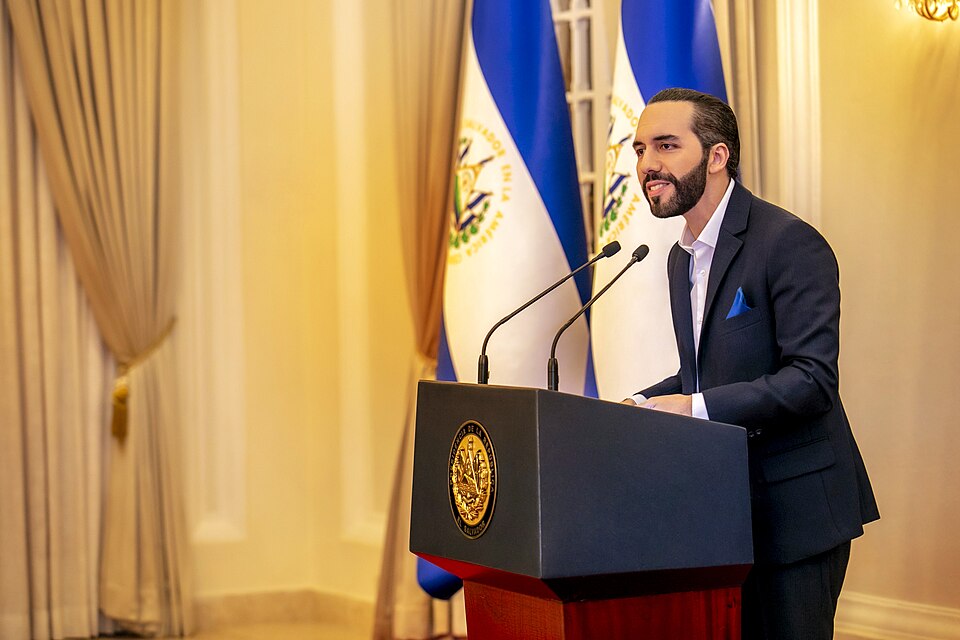
On 10th November, El Salvador’s president Nayib Bukele announced on X that two days ago, a joint strike on the supposed home of Haitian 400 Mawozo gang leader Lanmo San Jou was conducted by Haitian police and armed forces, supported by Salvadoran troops in Croix-des-Bouquets, reportedly killing 20 people (Al Jazeera; BBC News). Haiti’s prime minister, Fils-Aimé, thanked Bukele on X for his “commitment of the Salvadoran forces in the fight against the gangs” and declared that “THE GANGS WILL GET NO SLEEP!” (X).
This is not your average military intervention by a major power into a failed state. This is a developing country with little to no history of independent foreign deployments, sending troops to wage a war against criminal gangs in a foreign country with no public rules of engagement. So why is a Central American country with a population of around 6 million people, with a military that last fought against its neighbour in 1969 over football (true story, look it up), deploying a tenth of its army to a country almost 2,000 kilometres away?
Haiti has been in a long-brewing crisis for years. It is one of the poorest countries in Latin America, with more than half the population living on less than $ 3 USD a day, more than a million people displaced by gang violence, and 5.7 million people facing severe food insecurity (Humanitarian Action; World Bank; IOM; UN OHCA). This was kicked off by the assassination of the late Haitian president Jovenel Moïse in July 2021 (BBC News). The country’s government and law enforcement services have since then, by all measures, ceased to function, allowing criminal gangs to run rampant, controlling 90% of the nation’s capital, Port-au-Prince (Human Rights Watch).
The international response to Haiti’s collapse has been, like most large-scale humanitarian crises in the developing world, slow and underfunded. In 2023, the United Nations authorised a Kenyan-led Multinational Security Support (MSS) mission to help stabilise the country, but chronic underfunding, limited operational capacity, and insufficient personnel limited its effectiveness (UN News). Even after replacing it in 2025 with the UN Gang Suppression Force (GSF) and expanding it to 5,500 troops with a new mandate and broader operational parameters, its impact remains limited (The New Humanitarian).
President Bukele’s justification for intervening stems from 4 Salvadoran aviation technicians serving in the GSF who went missing in an ambush on the 18th of October, and whose bodies were not returned by the criminal gangs responsible (BBC News). However, Bukele’s goals for the intervention force have now expanded to combat the criminal gangs that have overtaken Haiti since 2021, proclaiming that he is helping Haitians to “take back your country from the traitors who betrayed Dessalines’s legacy” (X; Associated Press). For now, the intervention seems to be working. The 400 Mawozo gang reached out to the Haitian government on 6th November, calling for a ceasefire and negotiations, as well as an end to “international interference” (Associated Press). Self-serving as that demand is, it does raise a real and important question: who exactly is this force answering to?
The intervention also has a domestic political justification. After all, this is not the first time the Salvadoran president has fought against criminal gangs. Since 2022, he has declared a state of emergency in El Salvador and waged a heavy-handed war against gangs, imprisoning over 65,000 people in “mega-prisons” (Associated Press). Though his methods are questionable, it cannot be denied that he dealt a heavy blow to criminal gangs in his own country and rode the popularity wave that came from it. With a presidential election in February and approval ratings above 90% despite a lagging economy and democratic backsliding, a strong, decisive intervention in Haiti against violent criminal gangs would let Bukele remind the Salvadoran populace of his strongman image (Associated Press).
For many Haitians, the Salvadoran intervention has provided a glimmer of hope after years of instability, violence and lawlessness. Demonstrators in Port-au-Prince, Belladère, and Jérémie marched on 6 November, chanting “Debloke peyi a” (“unlocking the country”) and urging Bukele to take further action to rid Haiti of the criminal gangs (Haitian Times).
However, this deployment of forces has raised serious questions about accountability. El Salvador had deployed a force roughly 2,500 strong, most operating outside of the GSF’s command structure and rules of engagement. Groups like Amnesty International have called on President Bukele to disclose his deployment agreement with the Haitian government, the oversight mechanisms for the deployment, and to ensure the force operates within the boundaries of international human rights laws (Amnesty International). Even a Haitian human rights advocate who supports the deployment has warned that people living in gang-controlled neighbourhoods are not necessarily gang members (The Conversation).
This warning is important because security operations in Haiti are already deadly in their own right. Of the 5,519 people the UN recorded killed between March 2025 and January 2026, 3,497 died in operations against gangs, not in gang attacks (UN Human Rights Office). Analysts also question whether Bukele’s methods will be as effective in a different environment. Haiti’s gangs are far better armed than El Salvador’s ever were and deeply entwined with its political elite, which would likely force the Salvadoran mission to either push for “quick, symbolic victories” or an extended conflict that it could ill afford (Associated Press).
The world and its global institutions’ response to Haiti’s humanitarian crisis is a story often repeated in the global south: too slow, too small, and too underfunded. A year after the UN authorised the GSF, it has only around 2,500 personnel on the ground (The Conversation), and one contributing state has now decided to act unilaterally, deploying a force of equal size outside UN control. Whether Bukele leaves behind a safer Haiti or simply a stronger political campaign at home, Haitians will be the ones left to live with the consequences.
Featured image: Casa Presidencial El Salvador via Wikimedia Commons