
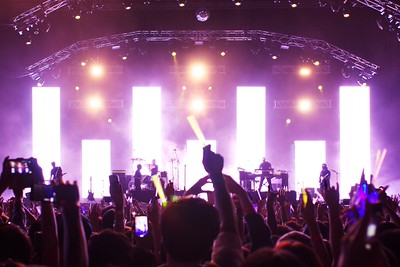
With the release of her of her third studio album ‘Lost Weekend’ and consequential world tour, Phoebe Bridgers’ new tour policies have become a source of contention online. An unheard-of policy in the realms of concerts and performances, she has encouraged a complete phone, photography and note-taking ban from her new audiences. Fans have been told to expect to surrender their phones to members of staff, who will place them inside sealed pouches, secured by a magnetic clasp until the end of the show. This tactical move is inevitably tied to the recent rise in anti-social phone-related behaviours at concerts, not just her own.
Poor concert etiquette has inevitably been on the rise, the catalyst surely a mixture between the advent of social media and general entitlement and individualism. Screaming out during slow songs, clapping at inappropriate moments and throwing items like bras, underwear, charms and other solids at the performing artist during their performance are all examples of behaviour artists shouldn’t have to suffer through while they attempt to share an experience with us. Billie Eilish’s ‘Hit Me Hard and Soft’ tour went viral online for various clips of crowd members screaming during her live layering of ‘when the party’s over’, ruining the looping effect. You can even see clips of Sabrina Carpenter getting agitated on stage after having various fan-made gifts thrown at her face. This surge of impolite behaviour makes Bridgers’ ban seem more reasonable by the minute, but the conversation is more nuanced than that.
The most pressing issue caused by this phone ban, some fans feel, is an impact on guest safety and ability to communicate with outside loved ones. Should, in the worst-case scenario, a threat becomes apparent, fans are concerned with the issue of not being able to call for help or say goodbye. While this is a more extreme scenario, I feel it is not unprompted, following the general spike in fear after the bombing in Manchester during Ariana Grande’s 2017 concert. Less intense, although still worthy of consideration, other practical issues arise from not being allowed access to phones. Phones have become the principal means by which we communicate in the 21st century. They have also become important stores of data, and with the invention of Apple pay in 2014, the practice of not bringing physical credit cards has significantly increased. Many may find themselves caught short should they need to buy drinks, foods or concert merchandise and paraphernalia. Being without a phone has simply become impractical in the modern age.
I also question whether the phone ban impinges upon the concert’s most base function – to provide an unforgettable experience. When we can no longer recall the unforgettable, we turn to media like diaries, photos or videos to trigger recollection. Attendees may not feel as though they are getting their money’s worth if they lose the primary means to make a concert eternal by taking home a token of the performance. Fleeting and vapid memories can be made untouchable through digital preservation, and it ensures that that magic can be lived endlessly. On a vainer note, lots of fans are generally upset about the inability to post their experience on their social media. Concerts hold a kind of social currency. As basic as it is, we as humans like to be able to boast about social signifiers like concerts, holidays, clothes etc. Few people are immune from the urge to make their private activities public.
Furthermore, the cost of the ticket and what privileges that cost affords must be taken into account. Should an artist be allowed to dictate how time is spent during a service/ exchange many fans save up to afford? Going to a concert has only become more expensive with time: the cost of the ticket itself, transport and overnight lodgings often all become part of the fanfare of the outing. The relationship between the performer and the audience has always been complicated, and we must question whether the artist is providing a service or a piece of art, and to what extent is the audience entitled to have control over the way the concert itself is shaped (if any control at all). The boundaries of this dynamic are blurry, yet fragile, and it is testy to impose limits on either party, so a delicate path must be walked so that the audience does not feel disrespected and the artist still holds full creative control.
Despite the negatives that crop up from this new policy, Bridgers’ new edict offers a glimmer of hope for the future of musical artistry. Instead of being lived through screens, the ‘Lost Weekend’ tour may instead be fully felt, so to speak. As famed theorist Boserup would say, ‘necessity is the mother of invention’. Instead of torchlights for what Coldplay has likened to a ‘sea of stars’, many American audiences have been bringing gas lighters to their shows to wave to tempo during her slower songs. Post-concert sketches have been etched and shared online so that online connection can still be made. Furthermore, the concert itself becomes a more holistic, bodily experience. Before, many fans would simply record the entire concert, scared to leave a single second uncatalogued, and now these fans have no other choice than to directly engage with the music and the twilight atmosphere of Phoebe’s performance. The stage is actually seen. The phone ban also acts as an equaliser. Shorter fans already have to suffer being submerged beneath the bodies of the taller crowd members beside them, especially in standing sections of concert halls, but at least now there isn’t the extra added height of someone waving a phone screen in your face and directly blocking your view of the stage. Being more present in the moment may also make some of those more obnoxious taller fans more spatially aware, and thus less likely to stand directly in the field of vision of those behind them. People often forget that concerts are a three-hour community, and it is our duty to look out for those around us.
If you were lucky enough to snag a ticket to one of her UK performances this coming winter, try and embrace this new policy to the fullest, and if you’ve had previous concert experiences, compare them. Does not having your phone have a truly fundamental impact on your experience? Was it more or less beneficial, and most crucially, did it achieve what it set out to accomplish? We must also question if phones themselves are the root of anti-social concert behaviours, or simply an aspect of it – does taking away the phone nullify this crop of bad behaviour?
Image Credits: jiman_yoon via Flickr