
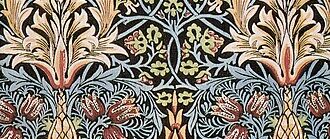
Durham’s English cohort should be no stranger to literature’s long condemnation of industrialism. First Year saw a Romantic quest for Arcadia laid out by Blake, only to be complicated by modern pastoralism and its deconstruction of that regimented nostalgia. This is a discussion more relevant than ever as we find ourselves surrounded by news of rampant industrialisation, a climate in crisis, and a growing estrangement between labour and product. Admittedly, I did not spend my summer lamenting our ‘Introduction to Poetry’, yet I felt it came to fruition upon my visit to the Fitzwilliam Museum’s most recent exhibition: ‘A Call to Art’.
The exhibition weaves together selected works of Millais and Rossetti, and rare sketches, furnishings, and textiles from Morris and Co. I feel the need to confess here that, although a literary contributor, my motivations were more artistic. In fact, I would go as far as to say that it was primarily the accompanying Pre-Raphaelites that caught my attention: Morris, to me, had admittedly meant childhood art lessons spent dabbling in potato printing. Having subsequently written off the exhibition’s textile portion as a charming addition (one that unfortunately did not fetch as much of my attention as my bus rattled closer), I fell into the common trap of overlooking the labour required of the more ‘domestic’ arts of weaving and embroidery. Placed alongside Morris’ Socialist manifestos, however, they raised questions I had not yet considered about the privilege of creation.
Those working under ‘The Firm’ were honoured with the ability to produce on their own terms. In his own manifesto, How I became a Socialist, Morris claims that ‘anyone who professes to think that the question of art and cultivation must go before that of the knife and fork…does not understand what art means, or how that its roots must have a soil of a thriving and unanxious life’. His ideal comprised a society in which ‘affairs could be managed without waste’ with no excess of ‘heart-sick hand workers’. This would certainly encourage readers to view the company’s most active years as the realisation of such a dream, where a prosperous reputation amongst Britain’s upper classes funded their collective bohemian fantasy.
In the same fashion as the exhibition’s Pre-Raphaelites, Morris drew much of his inspiration from the literary past. His reverence for the Medieval in particular was greatly inspired by John Ruskin, through whom he began to understand the era’s craftsmanship as a result of honest labour by fulfilled artisans. The period thus represented an epoch of community and beauty, with its guild system providing a bridge between worker and product that capitalism has since disintegrated.
As his confidence in socialism grew, Morris put forward the Middle Ages as the mythic foundation for a post-industrial future. To search for a future in the past may seem counter-intuitive, but when presented with the estrangement required to reach the present day’s level of industry, it is clear why the slow and artisanal process of an era predating automation proved particularly appealing. Looking towards his manifesto, once again, Morris warns that the ‘vulgarity’ of modern civilisation is well equipped to destroy art, our ‘one solace of labour’.
This is all very admirable, yet there remains one glaring inconsistency to unpack. The Fitzwilliam’s advertising clips foreground ‘radical vision’, ‘collective action’, ‘social change’, and ‘art for all’. The former three qualities may certainly be found in the collective’s attempts at a medieval revival, the establishment of their own firm, and Morris’ open support for Marxist ideology. However, the notion of ‘art for all’ clashes fatally with the company’s aforementioned customer base. The textile work of May and Jane Morris would sell for what amounts to several thousand pounds today, whilst proposed furnishings of St James’ Palace were considered too costly even for the royal family. How is it possible, then, that the creative process of Morris & Co. could represent a society free from class division? Morris was well aware that civilisation had reduced the workman to ‘such a skinny and pitiful existence, that he scarcely knows how to frame a desire for any life much better than that which he now endures perforce’. Despite costs reflecting a fair working wage and high-quality production, he became rightfully frustrated by their inaccessibility. Clearly, his realisation was not complete.
The exhibition ends on a delightfully open note: lush green walls and a singular honeysuckle print by May Morris, to remind us ‘of the joy to be found in nature’ and conclude that ‘the lasting legacy of William Morris and his circle is a message of truth, beauty, and hope.’ Visitors are presented with a final musing from Morris’ own News from Nowhere: ‘If others can see it as I have seen it, then it may be called a vision rather than a dream.’
Morris & Co. faded as dreams do, nonetheless: his increasing political activism and later death left the company in alternative hands, eventually dissolving in the early months of World War II. In spite of this sobering closure, I left the gallery feeling part of an ongoing vision, as I am sure those around me did. Morris revered art for its offer of a ‘full and reasonable life’, one to which beauty and real pleasure should be ‘as necessary to man as his daily bread’. This, to me, suggests a productive equilibrium.
The elevation of art alone as a manifestation of idealism risks a rose-tinted outlook, should we consider its tendency to ‘beautify’ all heights of suffering. This was glaring from the exhibition’s outset: Millais’ bride-to-be is striking only for the ephemerality of her freedom; Joan of Arc is pictured sword-wielding, with attention to her moment of power as opposed to its consequences; Helen of Troy provides foundation for the Pre-Raphaelite ‘stunner’, yet sits vulnerable at the heart of war. There lies a dramatic irony central to the visual arts which we may argue relies upon the knowledge of literature. The products of Medieval creativity display a society of artisans, whilst contemporary literature paints a society still divided by both education and situation. Although that rift sits arguably wider now—as workers are denied sovereignty over their own labour—Morris and his peers seem to have inadvertently romanticised its advent.
Morris & Co. ultimately gave form to a desire that survives today, but its lifespan speaks to the incomplete nature of their vision: no life lived in art can escape its social and political implications. Rejecting royal endorsements meant replicating structures of production that sought to undermine the value of artisanal labour; producing such large works sheerly for the joy of their existence would limit their distribution and reserve them for those privileged enough to access the training and means of production.
There is, however, still joy to be found in smaller, independent acts of creation. I interpreted ‘a call to art’ as rather a return to art, and literature by extension. It is in forgetting the works of our forebears that we risk hurtling further towards a society defined by obligation, disconnect, and mass-production. If art is an instinct as old as time itself, then literature provides a moving body to model it upon. Morris’ reconfiguration of Medieval motifs and artisanal values atop a foundation of socialist thought provided an admirable first step towards a society that champions the creative potential of the individual, the necessity of which the exhibition captured perfectly.
My bus rattled closer yet, and the first thing I did when I sat down was draw.
Featured image: William Morris via Wikicommons