1965, Dylan goes electric. The folk revival movement’s face unsentimentally plugs in a guitar and organ. His songs aren’t about protests now, he sings personally. His harmonica is still there, the way they know its Dylan. It all begins live at the Newport Folk Festival, the epicenter of the movement that had made his name. And they hate him. Shouting, booing, leaving and fighting. In Manchester, “Judas!”. “I don’t believe you” he says mockingly, turns to his band saying “play it f*cking loud”. He slinks into the back seat of a crowded car, puts his sunglasses back on and lights a cigarette, “It’s hard to get in tune when they’re booing” he says before a pause, “I don’t want to get in tune”. By daybreak he is asleep, slouched in the same spot.
The man I am talking about existed for little more than a year. Soon after returning from the States he would come off his motorbike at speed and come close to breaking his neck. He would not tour publicly for the next seven years, becoming a recluse. When he returned, he was not the same man that had gone electric.
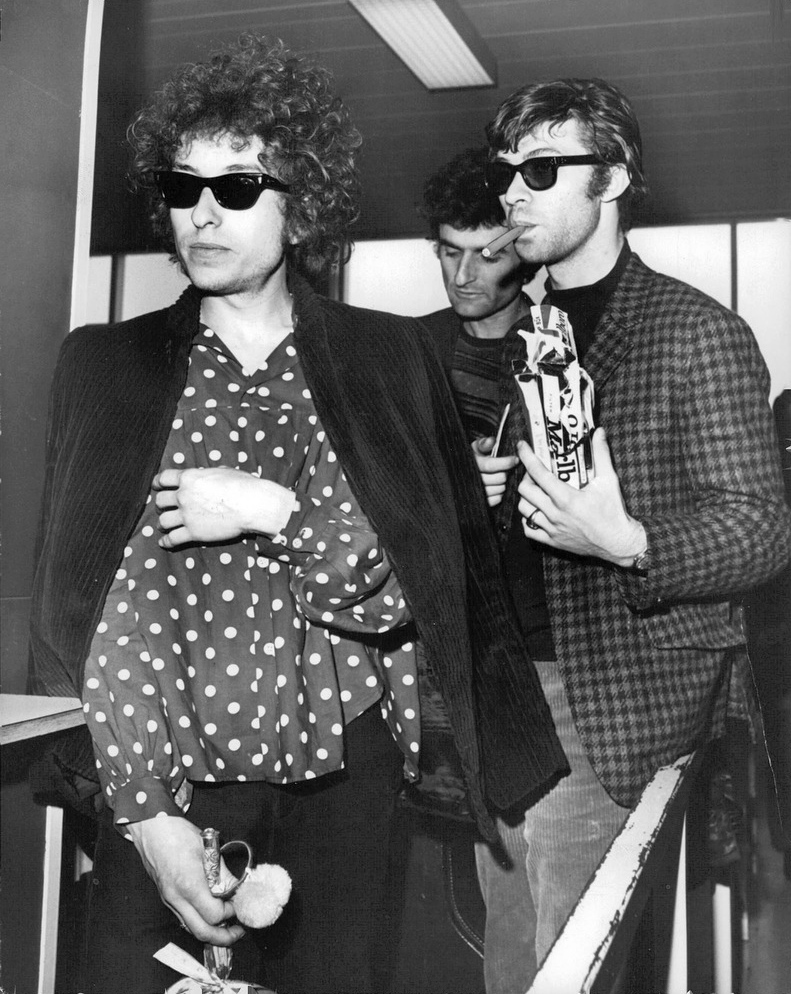
I don’t want to recount or interpret anything from this period. Hundreds of people knowing both more and less than me have done that. Nothing can be added from someone 60 years later that has seen a few recordings and listened to a selection of albums. What I want to know is why I keep watching this footage. Why have the candid moments, the defiant performances and the flawed man become so important to me? And why do I ask for no explanation or reasoning? I know I won’t use anything abstract to understand it. I won’t discuss “expression” or “artistic courage”, in all honesty I have only a vague concept of those nouns.
I don’t think Dylan went to Newport in 1965 looking for a fight. I don’t think he toured the UK to show the shift was permanent. I don’t think his electric guitar was a statement. I genuinely don’t think he knew what reporters were getting at with their questions. I don’t think Dylan was demonstrating something with himself, I think he was a man clinging on to it all. Most importantly I don’t think Dylan knew he was “going electric”, I think he started playing the electric guitar. And perhaps this is the way to see it all. Dylan didn’t stop playing folk, Dylan just kept playing his music. I don’t think he understood why they were booing at first. I don’t think it made much sense to him. But I think before he crashed he hated them as much as they had grown to hate him. And he sunk behind his glasses knew what the next album would feel like.
I passed a mattress shop twice in Newcastle. I walked past this to get to a contemporary gallery with its own restaurant on the top floor. The first time, its lights were off, its carpet strewn with rubbish and dust. Empty of mattress and only a sign in the window saying “last orders for delivery day”. I didn’t know what a closing shop meant by a marked day. Despite it all there was an unplugged kettle sat on the floor and even a desk without a computer. The second time I passed it I got in the way of a man moving unwrapped mattresses into a small open top rental trailer. The floor has more dirt on it now. There is an empty prosecco bottle on the windowsill. Left to be forgotten.
And I’ve seen art that perfectly embodies what Dylan had turned his back on. The optimism, the activism, the message and the movement. Paintings of strikes, revolutions and executions. They don’t remind me of the strikes I have been to. But I suppose I never went as an artist. I was there to make up a number and another flag in the crowd. And when I got home I wouldn’t write about it. I admire some of the artists that do but they always seem able to walk away from it at the end of the day. An ability that would have stopped Dylan’s boos and his crash in New York state. Preserved the man that died in 1966. A man that didn’t need his sunglasses and gave interviewers straight answers, a man who took it all a little less seriously. There’s something slightly uncomfortable about the idea of a man who went electric and stayed there.
Cover Image: Roger Pic via Wikimedia Commons
_(cropped)_(2).jpg)
Embedded Image: Unknown Author via Wikimedia Commons
