I remember picking up Hamnet after watching a Jack Edwards recommendation video on YouTube. It was another historical reimagining about William Shakespeare, except it wasn’t that. Maggie O’Farrell’s novel took the spotlight away from The Bard and gave it graciously to Agnes and her children, Susanna, Judith and the titular Hamnet. As a reader I was caught off guard by the power of silence and the quiet of her novel; Shakespeare wasn’t the successful playwright but the husband and a father and Agnes was not just his wife, Anne Hathaway. The landscapes and interiors of houses flooded the narrative and there was something powerful in it. Then in 2023, a screen adaptation directed by Chloe Zhao was announced, with Jessie Buckley and Paul Mescal in the roles of Agnes and William Shakespeare.
Zhao’s unique directing style blended well with the grounded realism of Farrell’s novel. However, the pressure was on Zhao to deliver something that harkened the success of the Academy Award winning Nomadland. She was also tasked with bringing to life an unorthodox period piece that did not rely on name dropping the Bard. She had also suffered somewhat from her cinematic venture into MCU with Eternals. Yet, her greatest successes came from the quiet exploration of grief. Hamnet perfectly caters to her directorial style, and Zhao delivers an emotional powerhouse of a film, that can hold a candle to Sinners, Frankenstein and Wake Up Dead Man. Her take on Hamnet isn’t reliant on spectacle and the source material doesn’t call for that. What Hamnet calls for is time; time to tell a story warped in grief, happiness and triumph. Zhao treats time with delicate consideration and gives it to every element of the film; be it the film’s cramped interiors or small pockets of forest that Agnes calls her own.
The film is made whole by its ensemble; with Jessie Buckley at the heart of everything. Within the span of two hours, Agnes becomes more than a wife. Zhao draws out flashbacks from Agnes’s past and weaves it effortlessly into the film all the while allowing Agnes to grow as a character. She is a flickering flame, a woman perceived to be the forest witch’s daughter and the film decides to feature her in bright red in a pool of greys and blues. Agnes is the fire and soul of the film and Buckley gives a career defining performance as the mother and wife, who is consumed by regret and grief. If Agnes is the flicker and fire, William is the opposite. Paul Mescal, in blue and grey lingers in the background, which isn’t inherently a bad thing. The film begs for him to embrace the roles of a father and husband, who just happens to be one of the finest playwrights in history. Mescal understands this and brings it to every dialogue and acting choice; his William isn’t the successful writer or romantic but the belittled son and the grieving father who honours his own son by dedicating a play to his name. The cast is rounded off by the likes of Emily Watson as Mary Shakespeare and Joe Alwyn as Bartholomew Hathaway. Yet, some of the film’s most memorable performances come from its youngest actors such as brothers Noah Jupe and Jacobi Jupe as the actor of Hamlet and the boy Hamnet. Their appearance though brief manages to be both captivating and gut wrenching.
Hamnet as a film triumphs with the moments that Zhao chooses to bring to life. The plague isn’t as prominent as it was in the novel and neither is William’s aspirations. They are mere factors in the film’s narrative and to Zhao they are parts of the story, not the heart of it. She looks beyond these behemoth ideas and histories and into something introspective and beautiful. She looks at dynamics and arcs that are rarely explored and brings them into the limelight of the film; it’s in the scene of William crying in a cramped room of the theatre and it follows Agnes when she sees her son in the place of Hamlet on stage. Zhao understands the significance of these moments and she lets them breathe a new life into a familiar story. Ultimately, her rendition of Hamnet is a song about the grief and living beyond that. The film is subtle and less spectacle oriented, unlike most films released in 2025. However, that’s when the film ultimately wins its audience over. It’s a film for the readers who were captivated by the vivid imagination of Farell and it’s a film for anyone who wants a bittersweet exploration of a family that falls apart before realising the weight of grief and distance. Not a spectacle piece, but an intimate film about death and legacy.
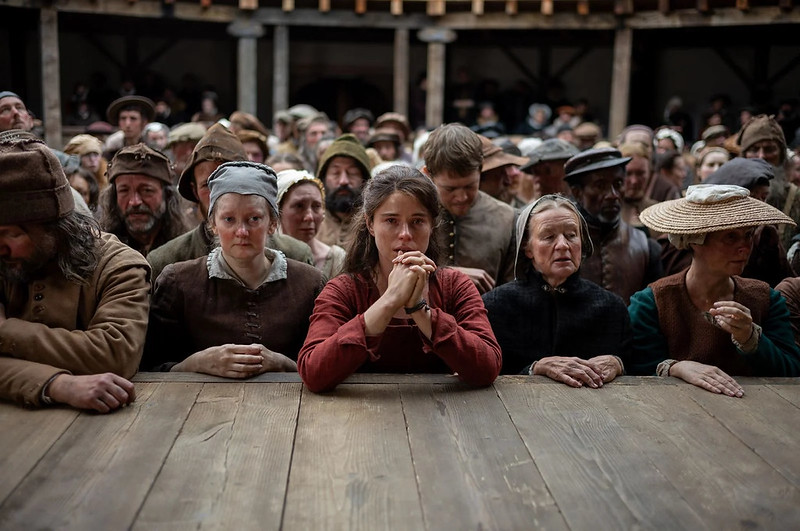
Image credit – Unification France via Flickr