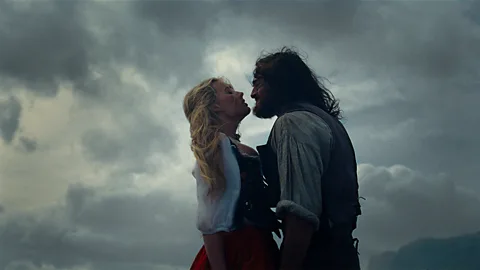
Wuthering Heights has arguably been the long awaited movie of 2026. Inspired by Emily Brontë’s 1847 novel, Wuthering Heights follows a lifetime of yearning between main characters Cathy (Margot Robbie) and Heathcliff (Jacob Elordi). However, many fans of Brontë have taken to the internet in raging fury with Emerald Fennell’s cutthroat adaptation, claiming Emily Brontë would be rolling in her grave over the clear destruction of a timeless classic novel.
One of the primary reasons the film was doomed to fail before it released was the glaringly irresponsible casting of Jacob Elordi as Heathcliff. In the original Wuthering Heights, much of Heathcliff’s character development is shaped by his experiences as a racialised outsider. Although his ethnicity is never explicitly stated, the novel repeatedly depicts him being beaten, degraded, and subjected to racialised slurs, clearly marking him as marginalised for being something other than a white male protagonist.
Against this context, Emerald Fennell’s decision to cast Elordi feels profoundly careless, particularly given her claim that casting choices were guided by how she personally imagined the characters while reading the novel. To envision Heathcliff as a white man is to erase the character’s experience of racial abuse entirely, flattening a crucial dimension of his alienation and rage. This erasure points to a broader problem in Fennell’s interpretation of the text: a white, privileged reading that prioritises personal fantasy over the novel’s engagement with racial otherness and systemic cruelty.
Further, Emerald Fennel has received significant heat online for her blatantly ‘horny’ portrayal of Cathy and Heathcliff. In the novel, the power of their relationship lies not in erotic fulfilment but in prolonged yearning, repression, and psychological torment. It is precisely this lack of physical union that intensifies their obsession and renders their bond so destructive. With the rise of ‘BookTok’ culture, there seems to be a clear selling of sex, seemingly tailored to fans of modern romance authors such as Colleen Hoover, rather than engaging seriously with Brontë’s radical gothic vision. By translating emotional and metaphysical longing into overt sexual imagery, the film fundamentally misunderstands the source text. I would argue the importance of the yearning and torture between the characters is due to their lack of erotic immediacy, and this is totally destroyed by Fennel in the new adaptation. Robbie and Elordi are pictured in various states of undress and sexual intimacy in numerous scenes throughout the film. While there are no explicitly nude scenes in the film, the racy nature of romantic encounters is undeniable, and a fairly lengthy montage of Elordi and Robbie features early in the film, soundtracked by Charli XCX. In doing so, Fennell not only sensationalises the relationship but dismantles the very tension that gives it meaning, replacing gothic anguish with stylised sexual excess.
A further issue I have with the new adaptation is the choice to end the adaptation halfway through the plot of the novel. While it would be impossible to include every detail of such a groundbreaking work in a feature-length runtime, the omission of Cathy’s haunting presence during Heathcliff’s later years is particularly damaging. This spectral continuation of their bond is absolutely paramount to the novel’s gothic yearning and supernatural atmosphere—elements that are almost entirely absent from Emerald Fennell’s adaptation.
That said, there are moments of visual and performative invention worth acknowledging. I absolutely loved the addition of the ‘skin room’ modelled on Robbie’s own complexion, featuring freckles, moles and veins. Likewise, Jacob Elordi’s delivery of Heathcliff’s final lines, lifted directly from the novel, is powerful and restrained, demonstrating flashes of what the film could have been. Unfortunately, these isolated successes are not enough to salvage the adaptation as a whole. Without the novel’s latter-half descent into haunting, decay, and unresolved longing, an unrepresentative casting of Heathcliff and the sexualisation of the protagonist’s romance, the film collapses under the weight of its own misjudgements. Elordi’s performance may linger, but it cannot redeem what ultimately feels like a spectacular misunderstanding of Brontë’s gothic vision—an adaptation that gestures at depth while stopping short of its darkest, most essential truths.
Image Credit: https://ichef.bbci.co.uk/images/ic/480xn/p0mzbqkq.jpg.webp