

Crusader Kings II is a sandbox medieval simulator, in which you play as a noble dynasty, controlling individual members of that dynasty as they navigate the fluidity of medieval politics. The game draws heavily from medieval history – as you would hope – though, as with all things of this nature, it cannot possibly be fully accurate (or even mostly accurate, arguably). In this article, I want to share with you why I think the historical value of this game is understated, relating to broader arguments around historical fiction. In doing so, I will first recount the story of how the Bohemians came to rule the Holy Roman Empire (non-canon). Then, I will discuss how this story relates to three historical themes: the personal aspect of power, the realities of an elective monarchy, and the mythologisation of history.
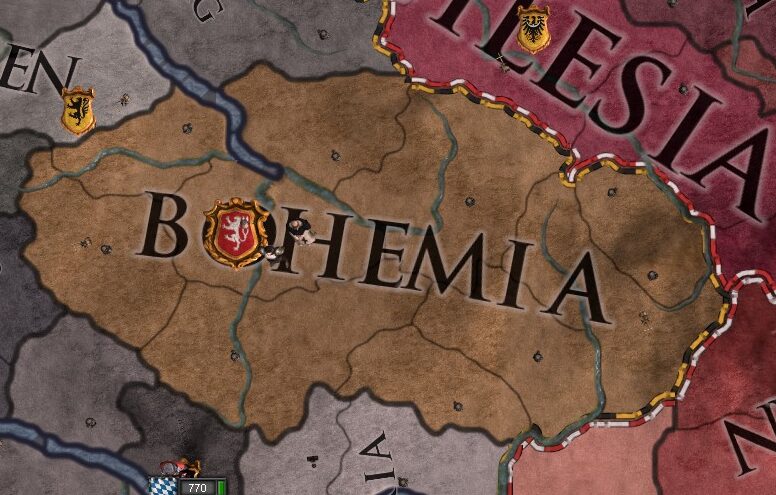
Vratislav of House Premyslid, Duke of Bohemia and vassal of the Holy Roman Empire (HRE). Sometime in the early medieval period.
Vratislav controlled the de jure lands of the Duchy of Moravia; he anointed himself Duke of Moravia, then King of Bohemia, becoming one of the strongest vassals of the HRE. He spent the rest of his reign consolidating his realm, and upon his death, his brother Konrad would succeed to the throne.
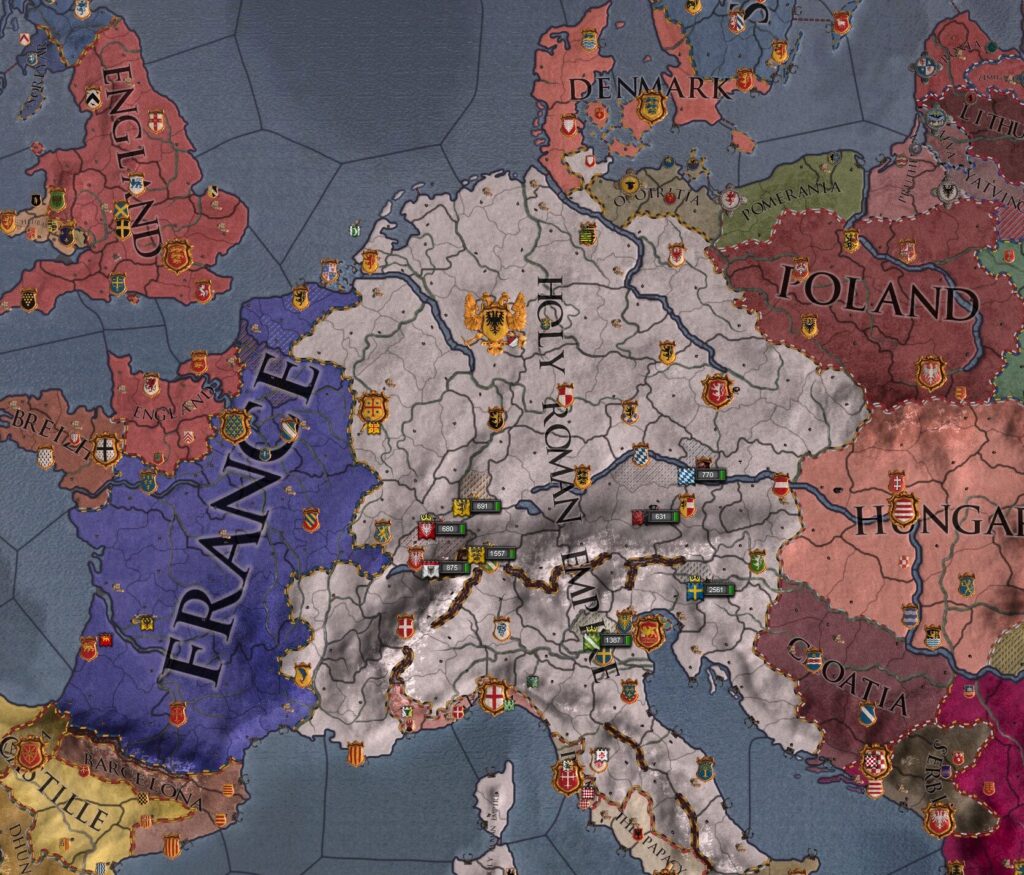
Konrad was ambitious and he made it clear from the beginning he wanted to be Emperor. He had six children, which he used to create powerful marriage alliances both within and external to the HRE. Externally, he allied with the Kings of England, Poland, and Croatia; internally, he allied with the Dukes of Aquitaine and Brandenburg.
An opportunity presented itself as the Emperor’s war with France came to an end. The war had been long and difficult, concluding in a stalemate. The nobility were angry at the Emperor, and with this anger, Konrad rallied them in support of his claim for the crown. He managed to win over a number of supporters, key amongst them being the Dukes of Saxony and Steiermark, and the Duchess of Tuscany. With this faction and his alliances, he had influence over almost half of the HRE.
Then came the decisive moment. He offered the Emperor an ultimatum, threatening rebellion if he did not surrender his throne. The Emperor refused. War was declared.
The war lasted only a few years, but it was exceedingly difficult, even with the support of Konrad’s foreign allies. The Emperor’s forces still outnumbered them, and coordination between the rebels proved difficult. The situation worsened when imperial forces besieged Bohemia.
By a blessing from the Almighty Himself, Konrad was able to lift the sieges of Bohemia, reply with his own sieges, and eventually, pressure the Emperor into surrendering. Konrad Premyslid became the new Emperor.
Konrad ruled for roughly twenty years. In that time, he maintained a period of stability, securing the favour of the council and successfully putting down the few risings that sought to oppose him. He also extended HRE influence on the Iberian peninsula by conquering Navarre.
Unfortunately, Konrad died suddenly, by a drunken accident (fell off a balcony). The succession was never secured, and imperial rule passed to another noble, not his heir, breaking the Premyslid dynasty before it could begin. His heir, his son, was left with only the Kingdom of Bohemia to rule. By this point, the Kingdom had shrunk to such an extent its territories were now smaller than the original Kingdom founded by Vratislav. The dynasty that had achieved so much so quickly had collapsed, in equally rapid fashion.
The Personal Aspect of Power
The personal aspect of power is present throughout the story. Legitimacy was not the only motivator of power; personal connections were vastly important. That was why the Emperor was usurped and why Konrad could exploit the anger of the nobility. The nobles were loyal as long as it benefitted them; as soon as it didn’t, they defected. Additionally, Konrad himself was important in securing his power, such as through dynasties and factions. He lacked a de jure claim to rulership of the HRE, but he still secured support, and eventually, control through his personal connections.
Historically, the aspect of personal power is all but omnipresent amongst the medieval HRE, particularly due to the power of the prince-electors. There were various rebellions and usurpations, but I will highlight that of Wenceslaus IV at the turn of the fifteenth century.
Wenceslaus was a Bohemian, and as such, focussed his court on the Bohemian nobility. This angered his nobles, who would later turn on him.1 Hlaváček argues the grievances of the electors were “markedly subjective [in] nature, with little bearing on the realities of the situation.”2 Thus, he highlights that legitimacy alone was not enough to guarantee rulership; one needed to maintain positive personal relations with their princes.
Realities of Elective Monarchy
This story highlights (if indirectly) the reality of an elective monarchy. The HRE was an elective monarchy, meaning imperial inheritance was decided by the prince-electors: a powerful group of German nobles. Without the guarantee of primogeniture, a dynasty’s position was fragile. If a monarch wanted to secure their heir’s election, they needed to maintain good relations with the prince-electors.
Konrad’s unexpected death after twenty years of rule, without succession secured, shattered any hopes of the Premyslid imperial dynasty. This was the case historically, as seen between the years 1250 to 1493, where “son followed father on the throne only once.”3 There were many civil wars and contested elections, such as the double election between Louis IV and Frederick the Fair in 1314. As mentioned earlier, the nobility were loyal to the Emperor as long as it benefitted them. This linked to a growing trend of declining centralisation during the late fourteenth and the fifteenth centuries, where the power of the prince-electors grew.4
Mythologisation of History
Finally, we come onto the creation of historical narratives and myths. These are narratives many of us will be familiar with, often popularised through popular fiction. Examples include Richard III and the princes in the Tower, the marriage addiction of Henry VIII, and the fighting legends of Henry V and Richard the Lionheart.
In a way, this article is itself an example of this mythologisation. The way I presented Konrad’s story has no doubt leant more towards the dramatic side of his tale. Are you really interested in his tax policies? That his is a fake history is itself an interesting point. If this is your first introduction to the HRE, after reading this article, you could remember Konrad more than you do real Emperors such as Louis IV or Charles IV.
Notice how the story of Konrad is about accumulating power. Konrad is not a peasant; he inherited the title of King. Historical myths and narratives can often focus on rulers, on nobles. There is nothing inherently wrong with that, but in popularising those narratives, we can sometimes sideline other voices of history. The peasants. The workers. The commoners. These narratives essentially decide for us which parts of history are important and worth keeping, and by focussing on rulership, Crusader Kings II contributes in a way to that perception.
Conclusion
To conclude, I set out writing this article to demonstrate how historical fiction (such as video-games) may contribute to our understandings of history. While we cannot treat these as factual sources, the way they immerse us and actualise us in the themes of the period is certainly valuable, and Crusader Kings II does it by putting you in the shoes of a ruler. However, historical fiction, by design, must have a narrow(er) focus. That is not necessarily a fault, but it does mean recognising these fictions may contribute to our preconceptions of history and what it meant to live in these past times.
Bibliography
Hlaváček, I. (2000), ‘The Luxemburgs and Rupert of the Palatinate, 1347-1410’, in Jones, M. (ed.), The New Cambridge Medieval History, Vol. 6: c.1300-c.1415, (Cambridge: Cambridge University Press), pp. 551-69.
Scales, L. (2005), ‘Late medieval Germany: An under-Stated nation?’, in Scales, L. and Zimmer, O. (eds.), Power and the Nation in European history,(Cambridge: Cambridge University Press), pp. 166-91.
- Hlaváček, I. (2000), ‘The Luxemburgs and Rupert of the Palatinate, 1347-1410’, in Jones, M. (ed.), The New Cambridge Medieval History, Vol. 6: c.1300-c.1415, (Cambridge: Cambridge University Press), p.559. ↩︎
- Hlaváček, I. (2000), ‘The Luxemburgs and Rupert of the Palatinate, 1347-1410’, in Jones, M. (ed.), The New Cambridge Medieval History, Vol. 6: c.1300-c.1415, (Cambridge: Cambridge University Press), pp.560-61. ↩︎
- Scales, L. (2005), ‘Late medieval Germany: An under-Stated nation?’, in Scales, L. and Zimmer, O. (eds.), Power and the Nation in European history,(Cambridge: Cambridge University Press), p.171. ↩︎
- Hlaváček, I. (2000), ‘The Luxemburgs and Rupert of the Palatinate, 1347-1410’, in Jones, M. (ed.), The New Cambridge Medieval History, Vol. 6: c.1300-c.1415, (Cambridge: Cambridge University Press), p.569. ↩︎
Featured image: Alexey Savchenko via Unsplash