
Behind closed doors (without Ukrainian or European input), Kremlin envoy Kirill Dmitriev and a US special envoy led by Witkoff created a 28-point ‘peace’ plan to end the war in Ukraine. Its provisions are in effect calling for a Ukrainian surrender. Given the United States’ involvement, it is very difficult to dispute the idea that the Trump administration is on Russia’s side in this war. The proposal calls for Ukraine to give up its sovereignty and its territory, whilst Trump, with the removal of sanctions on Russia, has the go-ahead to benefit from an energy deal with Russia financially. The proposals are undergoing further revisions by the US and Zelenskyy. It will be a huge diplomatic undertaking for all actors – Ukraine, the US, Russia, and Europe – to agree on a plan. The Kremlin has already judged the alternative 24-point plan produced by European leaders as ‘unproductive’, and Ukrainians view an acceptance of the current terms as suicide.
The following article will outline the most obvious flaws in the 28-point plan: its “confirming” of, then proceeding to challenge, Ukraine’s sovereignty; its giving Russia exactly what it wants in terms of territory and a lack of explicit security guarantees for Ukraine; and its ensuring the US and Russia can mutually profit. To caveat, there are many more of the 28 proposals that can and should be criticised.
On Ukraine’s right to exist as a free nation, provision 1 calls to “confirm” Ukraine’s sovereignty, as if it were ever in question. It then, however, proceeds to make proposals that deny a sovereign country the rights it should, by definition, have. Firstly, the right to decide its own army size. The 600,000 soldier cap suggests the question, ‘Why is Russia concerned about Ukrainian troop numbers if it does not plan to re-invade Ukraine later down the line?’ Also, the mention of “reliable security guarantees” without any indication of what they are is very problematic for Ukraine. Ukrainians are already sceptical of vague pledges; the 1994 Budapest memorandum was similarly unclear and failed to deter Russian invasion in 2014 and in 2022. Worse still, the document only outlines the security guarantees Ukraine is not entitled to, such as the prohibition on NATO membership. Even though it is highly unlikely that NATO countries would approve Ukrainian membership, a sovereign nation should be able to decide which alliances it wants to enter into.
Next, the document gives Putin exactly what he wants: Donbas and no serious consequences if he violates the treaty. It calls for Ukraine to give up the entire Donbas region and for it to be recognised as de facto Russian. Russian troops do not have complete control of the Donbas region, so it demands that Ukraine withdraw from its own territory, which it currently still has some control of. This would lead to the displacement of thousands of Ukrainians, as well as having Ukraine surrender its fortress belt, which has functioned as a bulwark against the Russians since 2014. The zone would be a ‘neutral demilitarised buffer zone’, but if Russia re-invades, the Ukrainian cities of Dnipro and Zaporizhzhia would be severely exposed. In the instance of Russia re-invading and violating this treaty, it will face very little consequence – just the reinstatement of sanctions – so Russia would essentially be reinstated to its present-day position, which has clearly not disincentivised it from attacking Ukraine.
Finally, provisions 13 and 14 are very telling of Trump’s stakes in this war. The former calls for Russia to be ‘reintegrated back into the global economy.’ Sanctions will be dropped, and the US will collaborate with Russia for its own profit. This keenness to cooperate with Russia is highly contentious, given that the rest of the proposals utterly fail to punish it for its aggression. Suggestions like full amnesty to those involved in the war rule out the prospect of Russia being taken to trial for its war crimes, of which there is plenty of evidence. Also, incredibly boldly, almost unbelievably, the US wants to assume control of frozen Russian assets. This is despite the majority of the $300 billion in immobilised assets being held in Europe. $100 billion would be used for a US-Ukraine investment plan. Even more striking is the US’ demand that Europe invest a further $100 billion and that the remaining funds go towards a US-Russian investment project. The US, in effect, will have access to half of Russia’s money after having forced Europe’s hand into contributing. To nobody’s surprise, Europe rejected US control of Russian funds in its 24-point revision.
Historian Timothy Snyder so accurately summarises the 28-point plan as: “demanding everything of Ukraine, and nothing of Russia, its purpose is imperialism and profiteering.”
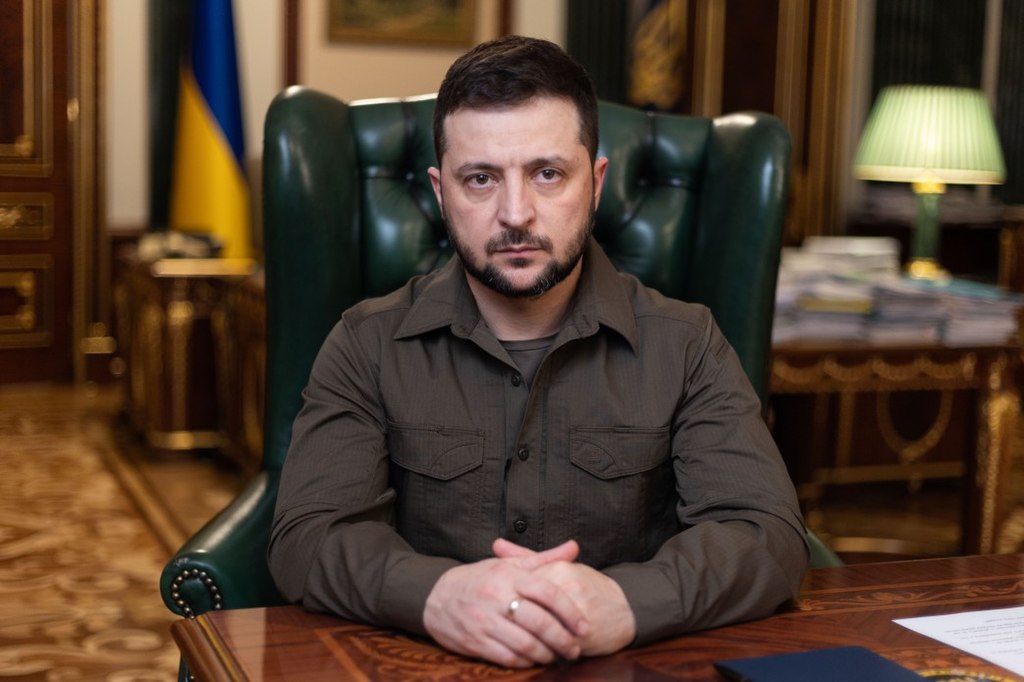
Image: The Presidential Office of Ukraine via WikimediaCommons

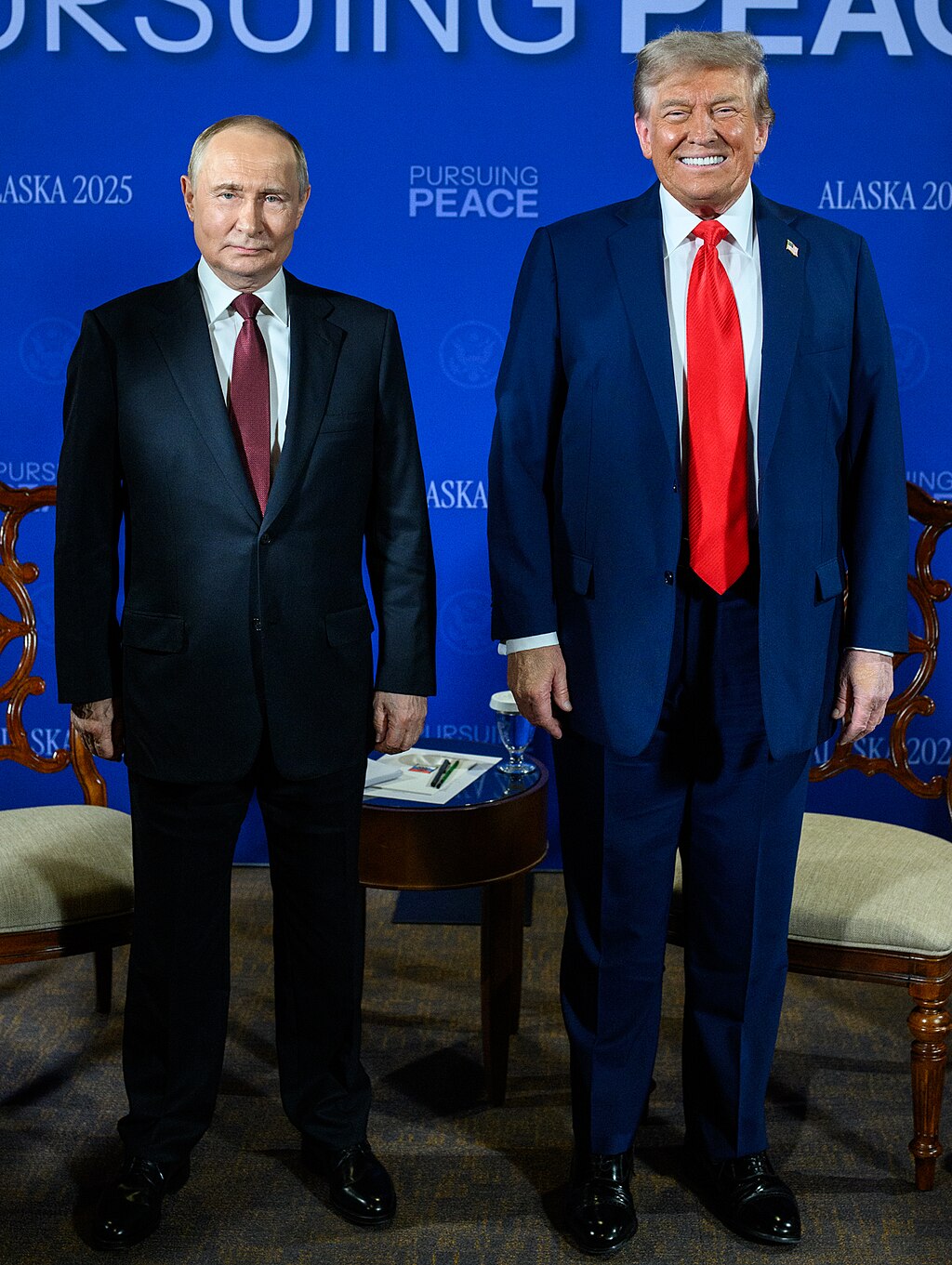
Image: President Trump and President Putin standing together via WikimediaCommons
